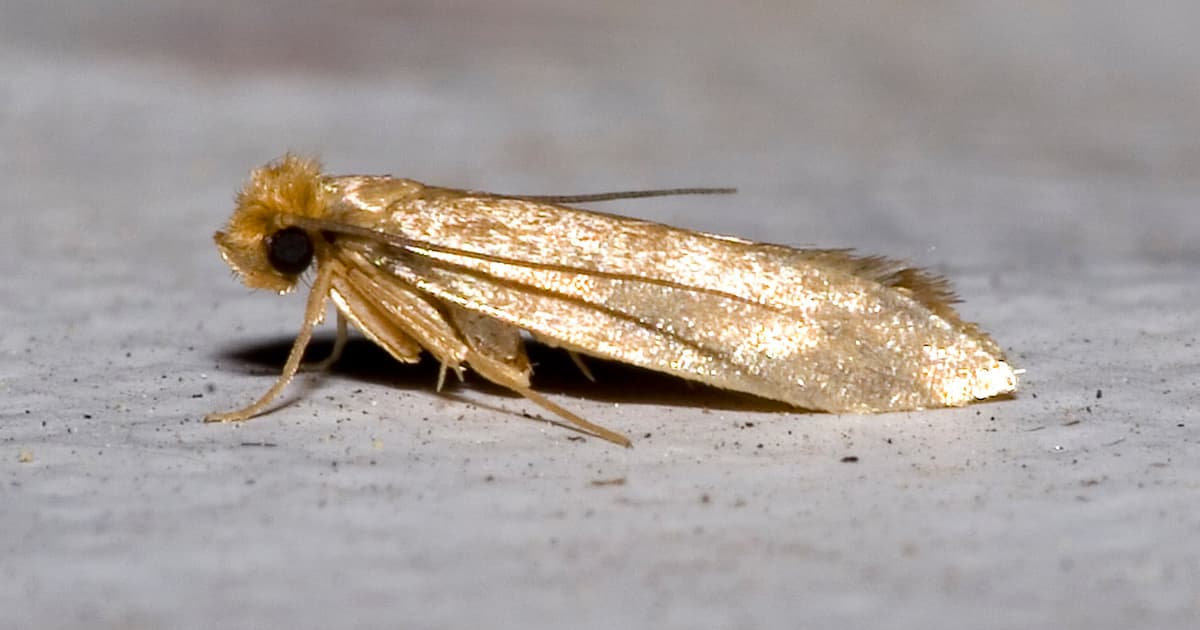

Finding one small moth in September does not mean disaster, but it is worth treating as a prompt to look. English Heritage notes that one generation of the common clothes moth usually takes a year, while warm conditions can allow up to three. A centrally heated home gives them a longer season, and it gives you less time to wait and see.
First, work out what you have
Holes in wool have a few possible authors. The table is drawn from English Heritage, the National Trust and Which?.
| Culprit | What to look for |
|---|---|
| Common or webbing clothes moth (Tineola bisselliella) | Adults about 5 to 8mm, silvery gold, that scuttle more than they fly and avoid light. Silk webbing and droppings on the cloth, with ragged holes or threadbare patches. |
| Case-bearing clothes moth (Tinea pellionella) | About 7mm, pale grey-brown with dark spots. No webbing. The larvae carry open-ended cases, and empty cases look a bit like grains of rice. |
| Carpet beetle larvae ("woolly bears") | Small hairy larvae. The adult beetles leave textiles alone, but the larvae make holes in wool, fur, silk and upholstery. |
The treatment below works against moths and is a reasonable start for beetle larvae too. If you cannot tell which you have, a pest professional can confirm it.
The order of work
- Hour one: take everything outEmpty the wardrobe or drawers completely. Check each piece in the creases and folds and behind the labels, which is where English Heritage says to look. Under a collar and inside turn-ups are also worth a look. Set aside anything with damage, webbing or cases.
- Hour two: clean the spaceVacuum the base, edges and shelves, then the gaps and joins, and wipe with a damp cloth. Go on to the carpet nearby and the skirting boards. Empty the vacuum into a tied bag and put it in an outside bin the same day.
- The same day: bag and freezeSeal woollens in plastic freezer bags and put them in the freezer. English Heritage calls freezing the most effective method for killing adults, eggs and larvae, at -18°C for at least two weeks. The National Trust gives about 14 days as well.
- Two weeks later: thaw, then cleanLeave the bags sealed until they have come back to room temperature, so that any condensation forms on the plastic and not on your jumper. Then wash what can be washed and brush the rest.
- Afterwards: put things back cleanStore them clean, in sealed boxes or vacuum bags if they will not be worn for a while. Shake out hanging clothes at least monthly. Moths dislike being disturbed.
Why the freezer and not the washing machine
Which? advises washing at 60°C or freezing at -18°C. For cotton, that is a choice. For wool it is not, because 60°C with the tumbling of a machine is a very good way of shrinking a jumper into felt. Unless the label says otherwise, your woollens go in the freezer.
Dry cleaning seems like the obvious answer for a tweed jacket, but Which? warns that it does not eradicate moths and may spread an infestation. Cleaning has a place, as dirty clothes attract them more, but it is not a treatment. Freeze first. If a jacket will not fit in the freezer, or you have a rug or upholstered chair, English Heritage suggests a commercial freezer or a reputable company using controlled heat.
What the shop products will and will not do
The aisle is crowded, so it helps to know what each kind of product claims to be for.
- Pheromone traps attract adult moths. They are good for showing you the scale of a problem and where it is. Which? says they help monitor and reduce moths but will not eradicate an infestation.
- Cedar and lavender may put adults off. Neither does anything to larvae already in the cloth. Which? describes cedar-based products as an option for long-term storage, but the storage itself needs to be clean first.
- Sprays kill adults, and insecticide kills larvae only on contact. English Heritage notes that residual permethrin products can help, and that repeat treatment may be needed. Follow the product instructions and ventilate the room. If anyone in the house has breathing problems, or you have pets, check the product's guidance first or ask a professional.
- Old mothballs. Which? says naphthalene mothballs have been banned in the UK and EU since 2008. If you inherit a wardrobe with old ones in it, ask your council how to dispose of them. Do not put them back.
Where they come from
Which? says infestations often begin in dark storage, and often arrive with second-hand or vintage textiles. So this is the single most useful habit if you buy older clothes: treat every new-to-you woollen as suspect, and put it through the freezer before it joins the others. There is more on this in our guide to buying second-hand tweed.
A few less obvious places are also worth checking. English Heritage mentions old bird nests in lofts and open chimneys, which should be swept every year or two, since nests can harbour moths and their larvae. Those moths may then find their way down to the bedroom. Dead birds or rodents can feed them too.
Keeping them out for good
There is no one-off fix, only a routine, and a small one will do. The National Trust suggests opening wardrobe doors now and again to let air and light in, and giving each space a thorough clean once a year. It also has a neat way of checking whether damage is live: trace a chewed area onto paper with a soft pencil, then compare later to see if it has grown. Vacuuming under furniture and along the skirting matters as much as the wardrobe itself, because dust, hair and debris can feed them.
Once a piece is treated, the holes do not close themselves. Small ones are very mendable, and we explain how to darn a hole in a jumper separately.
When to call someone
If moths keep reappearing after a thorough clean, or the problem has spread to carpets and soft furnishings, Which? suggests a professional, such as a member of the British Pest Control Association, who can offer treatments including insecticide sprays and fumigation. English Heritage gives the same advice for large infestations. Ask what will be used and how long to keep out of the room, and check for any concerns about children or pets beforehand.