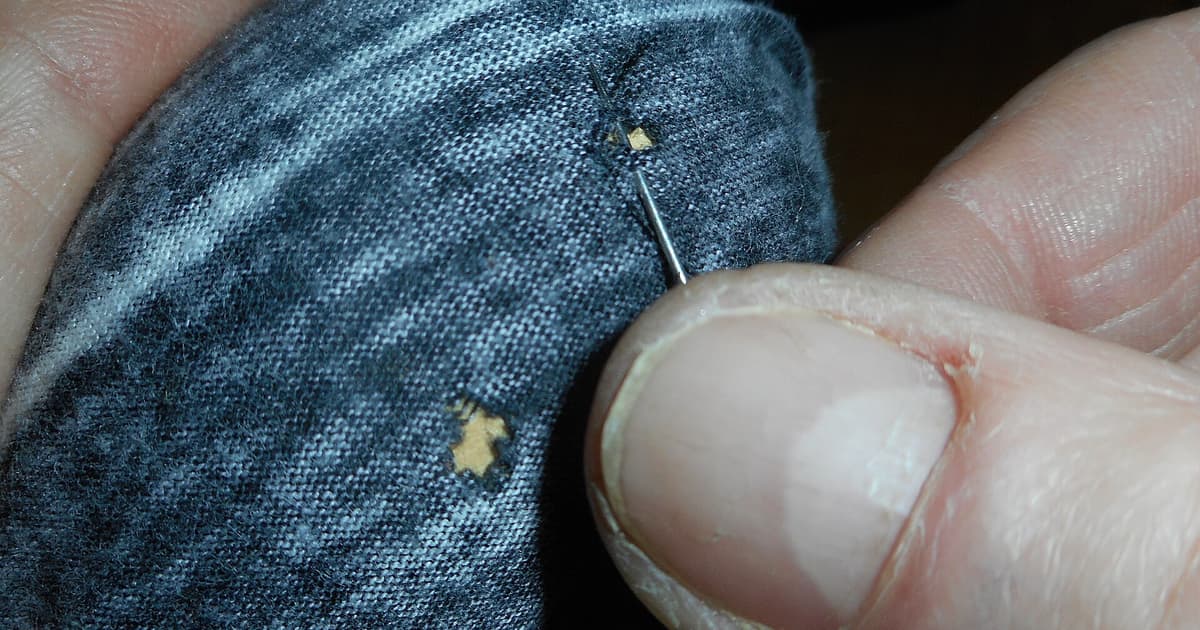

A darn is a tiny patch of weaving made with a needle. You lay down a set of threads to replace what has gone, and weave a second set through them. Nothing about it needs a steady hand or an eye for embroidery, and a first attempt on an old jumper will still be useful, if not pretty.
Before you thread a needle
Ask what made the hole. If it has the look of moth damage, treat the jumper first, or you will be mending around live larvae. The National Trust suggests putting a holed jumper in a sealed plastic bag in the freezer for about 14 days to kill eggs that may have survived washing. See our piece on clothes moths for the rest of that job. Then wash the jumper, because a clean knit is much easier to read and work with. Our washing guide covers that.
What you need
- Yarn. Oxfam's guide says to match the weight and thickness of the yarn to the jumper's knit. Wool on wool also behaves better over time when it is washed.
- A tapestry or darning needle. The blunt tip slides between stitches and does not split them.
- Something to hold the hole open. Oxfam recommends an embroidery hoop for jumpers. A darning mushroom is the traditional tool for socks, and a jar or tennis ball will do if you do not own one.
- Small scissors and decent light.
If the original yarn colour is hard to find, you have an easy way out, which is to stop trying. A contrasting darn is a perfectly respectable thing, and a colour that looks deliberate tends to look better than one that nearly matches. Try the shade against the garment in daylight before you decide.
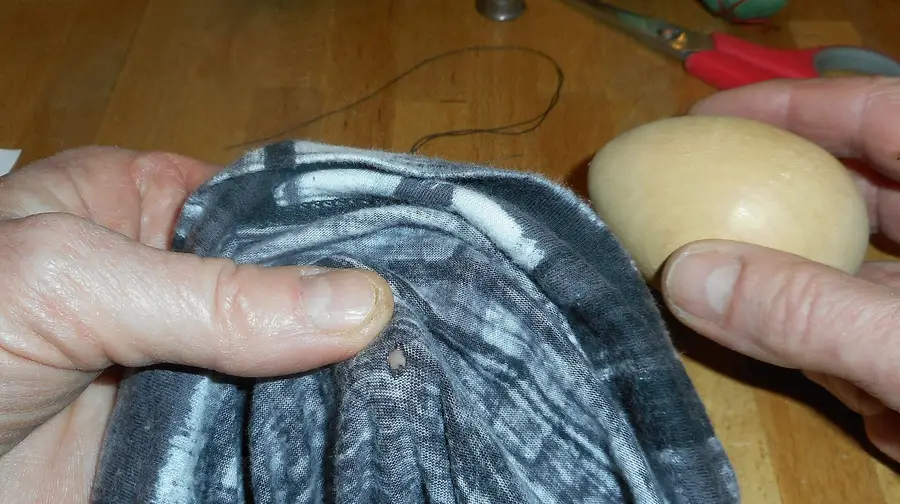
Photo: Wuerzele, CC BY-SA 4.0, source on Wikimedia Commons.

Making the darn
Our own drawings. Contrasting colours are used so that you can see the threads.
- Set up. Turn the jumper inside out and place the hole in the hoop. Line up the knit so the rows run straight, and avoid pulling it taut. It should be as relaxed as it is when you wear it.
- Trim only what is really loose. Snip away any straggling fluff, but leave the edges of the hole alone. If a stitch is about to run, catch it with your thread as you pass.
- Lay the first threads. Knot your yarn or leave a tail, and start in sound fabric a little way from the hole. Using a running stitch, sew a vertical line that follows the grain of the knit, cross the hole, and carry on into the good fabric on the other side. Turn and come back alongside. Repeat until the whole hole is covered with parallel lines, like the warp on a loom.
- Weave across. Turn the work and sew rows at right angles, going over one thread and under the next. On the following row, swap: under where you went over. Push each row gently against the last with your needle.
- Tie off. Finish on the wrong side, weave the tail into the back of the mend, and trim. If the patch feels loose on a heavier knit, Oxfam suggests weaving in more thread until it matches the surrounding fabric.
- Take it out of the hoop and wash it. A gentle soak helps the new yarn settle in with the old.
The commonest mistake is tension. If you pull each row tight, the mend puckers and the jumper bunches around it. Leave a very slight slack at the turn at the end of each row, so the darn has room to move as the knit does.
Small holes and thin patches
For a pinhole, the full weave can be overkill. Oxfam's method for small holes in socks works on fine jumpers too: with the right side out and a thin thread, pick up a stitch or two along one edge and then the opposite edge, working in a criss-cross, and draw it gently closed. Hide the knot on the inside.
A thin patch with no actual hole yet, such as an elbow going see-through, is the best moment to intervene. You can lay a darn over the worn area with no bridge to make, working it into fabric that still holds. Elbows and cuffs in particular will thank you, and you will avoid repairing a much larger hole next winter.
When a darn is the wrong answer
A darn replaces a small amount of lost fabric. It does not do everything.
- A run that has unravelled across several rows. Rescue the loose stitches with a crochet hook first, or the darn will sit over a ladder. If many rows have gone, ask a knitter or a repair service to pick them up.
- A very fine-gauge knit. It can be done with a thin yarn, but the mend is likely to show. Accept that, or take it to someone with the right skills, especially for something of sentimental value.
- Woven cloth such as tweed. Darning thread through a tweed jacket will mend the hole, and the Harris Tweed Authority describes its cloth as repairable with the simplest of tools. Still, on a good jacket we would ask a tailor first. Specialist invisible menders reweave threads taken from a hidden part of the garment, a job well beyond a home hoop, and worth a quote before you start with your own needle. Elbow patches are a time-honoured alternative when wear is the issue.
Keeping the mend
A well-made darn is usually sturdy, which means that the next thing to go will be nearby. When you find one hole, look over the same area and the matching elbow while your needle is out. And write down what yarn you used, or keep the end of the ball in a labelled envelope. If you buy older knitwear, it is worth looking at how we check second-hand pieces for damage in the same places.