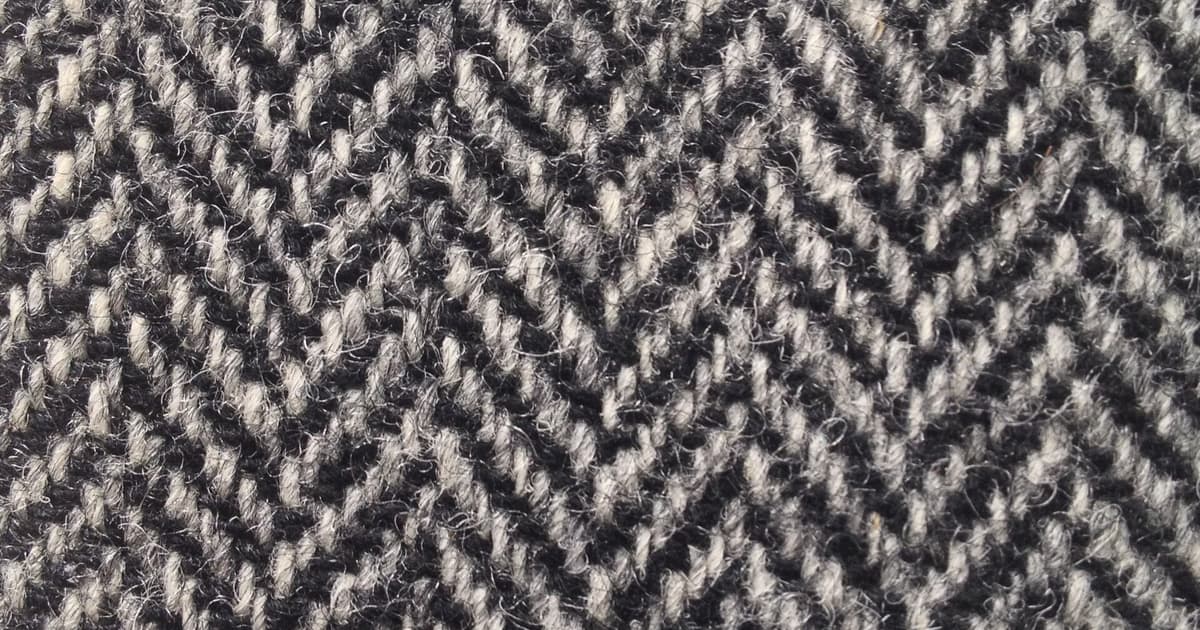

The two words get used as if they were rivals because they turn up on the same rail. Ask two questions of any cloth and the confusion goes. What is it made of, and how was it finished? That gets you to tweed, flannel or worsted suiting. Then, how do the threads cross? That gets you to plain weave, twill or herringbone.
The glossary from the Museum at FIT describes tweed as a wool fabric of irregular density and coarse texture, and treats herringbone and houndstooth as variations on it. It also calls herringbone one of the most popular weaves for suiting and outerwear, which is the clue that the pattern travels well beyond tweed.
Four ways to cross two sets of threads
Any woven cloth has warp threads running lengthways and weft threads running across. All a weave does is decide which set sits on top at each crossing. We have drawn four below. Each small square is one crossing: dark where the warp is on top, pale where the weft is. Houndstooth is drawn with both colours in both directions, which is the point of it.
Our own diagrams, generated from the thread order described in each caption. They show the principle and not any one mill's cloth.
Plain weave
Over one, under one. It is the simplest crossing, and many tweeds use it. A plain tweed has no diagonal at all, so any pattern comes from the coloured yarns.
Twill
Here each thread passes over and under more than one neighbour, and each row steps along by one, so the crossings line up into diagonal ribs. FIT's glossary notes that twills dominate menswear because the cloth drapes well and holds its structure. The name tweed may owe something to this. The traditional story, as Wikipedia retells it, is that "tweel", the Scots word for twill, was misread by a London merchant around 1831 as a reference to the River Tweed. It is a good story and we would treat it as one.
Herringbone
Take a twill and reverse its direction at regular intervals, shifting the threads at each turn so the ribs meet slightly out of step. The result looks like the backbone of a fish, which is what FIT says it is named for. Look closely at the join: the small break there is what separates a true herringbone from a simple zigzag.
Houndstooth
This one surprises people because the structure is ordinary. FIT describes it as a pointed check made with groups of four contrasting yarns in both warp and weft. Weave those colour bands on a basic twill and the jagged shape appears on its own. No thread is doing anything clever. The tooth comes from colour order meeting the diagonal.
So what makes tweed tweed?
Mostly the yarn and the finish, and the look they produce. Wool is dyed before it is spun, so that different colours can be blended into one yarn. The Harris Tweed Authority describes wools being weighed and blended to set recipes and then carded into a soft, fragile yarn. Hold a good tweed close and you can see this: what looks brown from across a room turns out to be several colours in each thread.
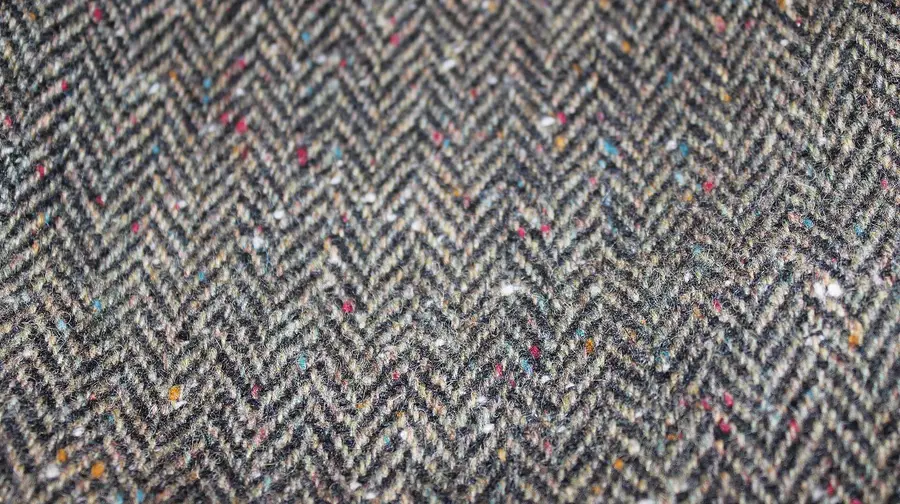
Photo: Toxophilus, CC BY-SA 4.0, source on Wikimedia Commons.

Compare worsted, which FIT defines by the spinning system, and which gives a smoother, more pliant cloth favoured for suiting. Weave worsted yarn in a herringbone and you have a herringbone that nobody would call tweed: fine and flat, with the zigzag so small that it can read as a plain colour from a few feet away.
The names you will meet on a label
| Word | It describes | Could also be tweed? |
|---|---|---|
| Harris Tweed | A legally defined cloth (see how to check it) | It is tweed, by definition |
| Donegal | A tweed with irregular nubs and flecks of colour, named for the Irish county | It is tweed |
| Herringbone | A weave | Yes, often |
| Houndstooth | A check from colour order on a twill | Yes, and in worsted too |
| Glen plaid | Small woven checks in muted colours with white, used for suiting | Sometimes |
| Windowpane | A large, simple barred check | Sometimes |
| Flannel | A loosely woven cloth of coarse, lightly twisted yarn | A different cloth, not usually sold as tweed |
How to read a cloth in a shop
You do not need any kit for this, only decent light.
- Step back, then come close. A pattern you can only see at arm's length is usually in the weave. Colours you can only see up close are usually in the yarn.
- Follow one rib with your eye. If it runs in a single direction across the cloth, that is a twill. If it turns back on itself in columns, that is a herringbone.
- Look at the reverse. Inside a hem or facing, the back of the cloth often looks different from the front, which helps you see which threads were doing what.
- Feel for the surface. A dry, slightly hairy cloth with some unevenness points towards tweed. Something smooth with a clean finish points towards worsted suiting.
Does any of this matter when buying?
A little, and more than you might expect. The weave affects how a cloth looks over distance. Herringbone tends to read as a soft texture from afar, which makes it an easy jacket to wear with other things. Bold houndstooth does not hide, so it needs more thought. When you are looking at older pieces, knowing the words also makes listings easier to search, and helps you spot a seller using "tweed" for anything vaguely textured. Our guide to checking a second-hand jacket picks up from there.
Be careful with claims of warmth or toughness based only on the weave name, since those depend heavily on the yarn and the weight of the cloth. A label that gives fibre content tells you more than a pattern name ever will.